Back to selected work

PayPal Servicing AI

Challenge
The PayPal Assistant needed to evolve its servicing experience beyond rigid flows to match modern AI expectations and intentionally reduce customer effort
Outcome
Meaningful reduction in contact volume, improvement in session resolution rate, and a more holistic AI servicing footprint across the product
My Role
Led design evolution of servicing AI experiences across the full arc, from early modernization through agentic platform migration
Outcomes
2x
Customer issue resolution rate within the assistant's agentic experience
Substantially reduced contact volume and cost to serve
4x
Increased customer adoption of the assistant as a primary self-service channel

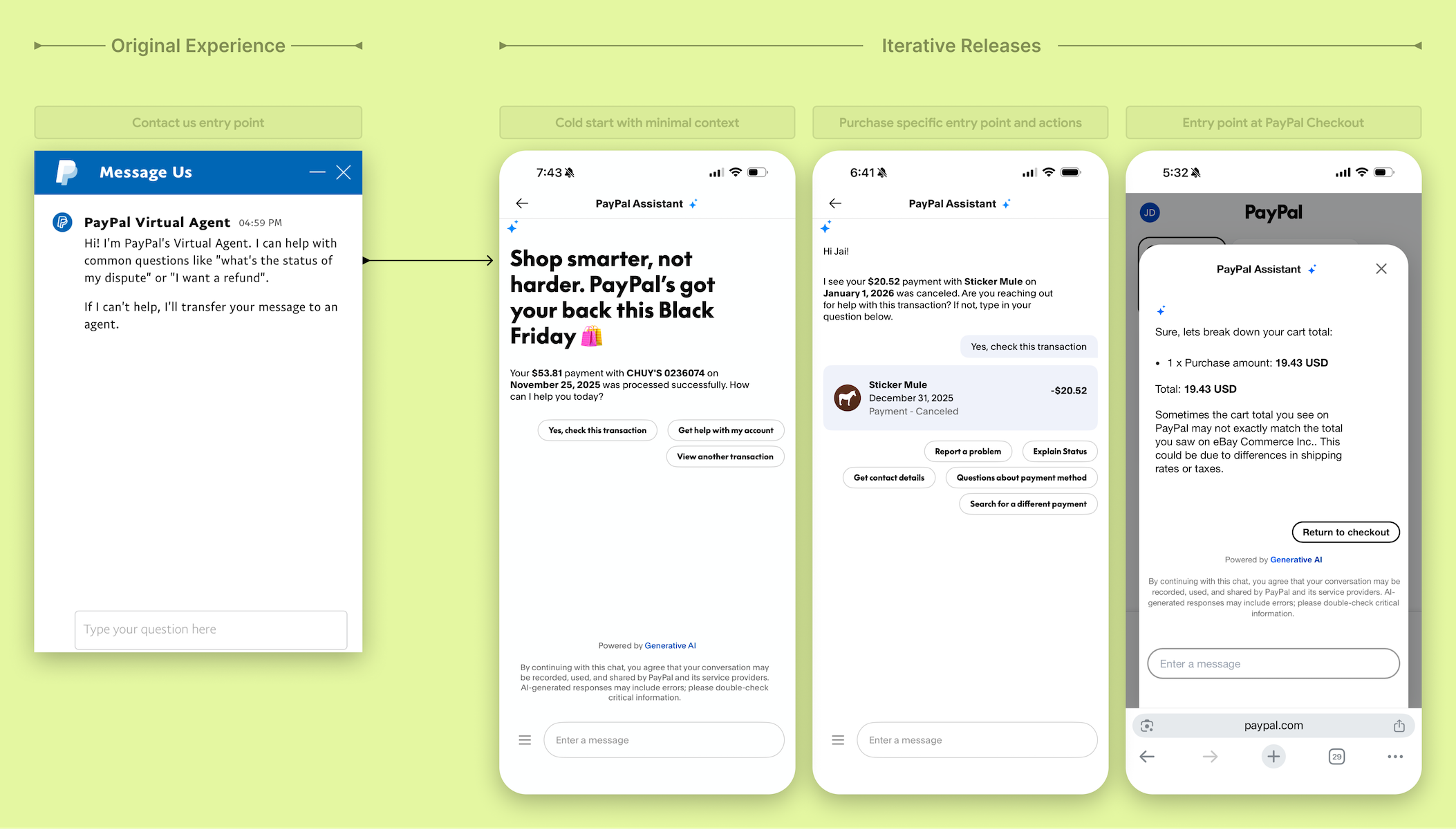
The PayPal Assistant started out as both a self-service channel and intake point for assisted servicing, capable of routing customers to FAQ links or a human agent, but unable to adapt to the nuance of what customers actually needed.

The quickly evolving world of AI was changing people's expectations of conversational experiences with customer support agents, which found the PayPal Assistant falling quickly behind. I embedded with the team to learn how the system worked and what was possible within existing constraints. This partnership revealed opportunities to modernize both the visual design and underlying functionality, making the assistant more helpful beyond simply linking to articles.
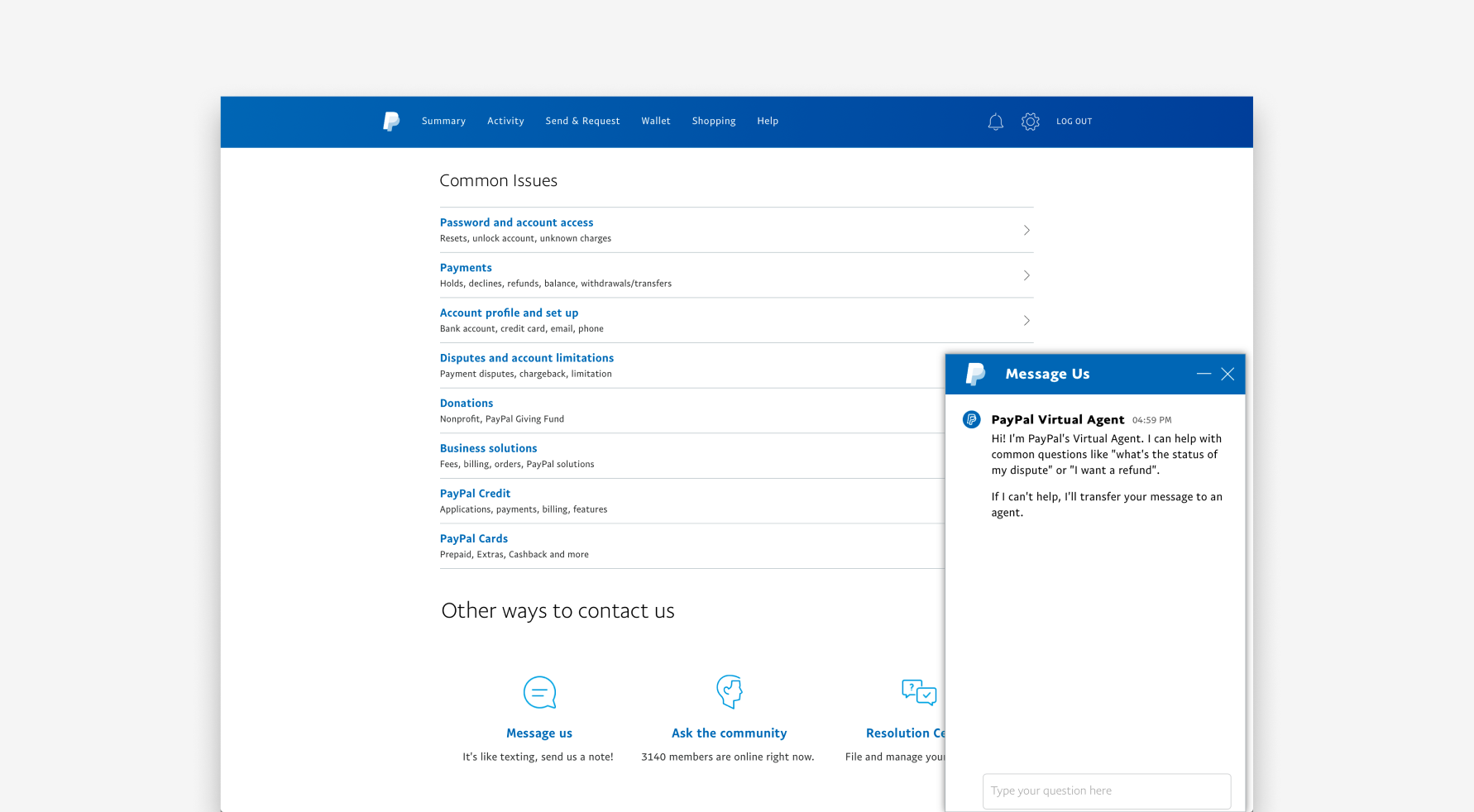
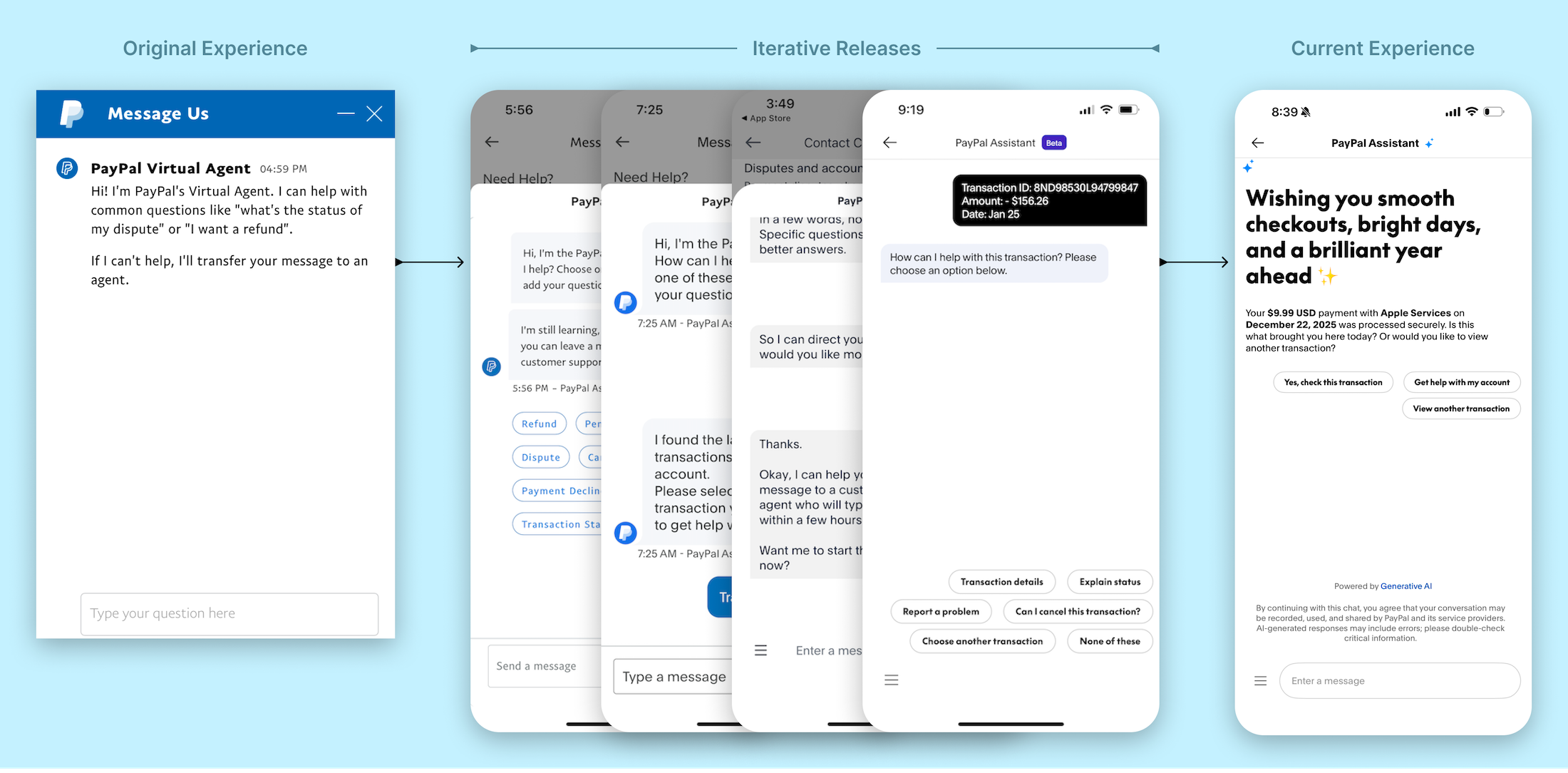
PayPal Assistant original state

We continuously evolved the assistant's visual design to match modern AI standards while transforming how product, engineering, and design partnered, shifting to faster experimentation with higher quality craft.

We iteratively modernized the interface by updating chat UI patterns, refining interaction details, and evolving the overall aesthetic to signal both capability and trustworthiness. We leveraged external audits, which we kept refreshing, to stay current with other AI assistant and messaging experiences.

Each evolution, no matter how small or organic, represented an ongoing effort to continually update the overall experience. As a byproduct of this journey over time, the working relationship between product, engineering, and design shifted to prioritize faster experimentation and value higher quality craft.

Messaging process evolution

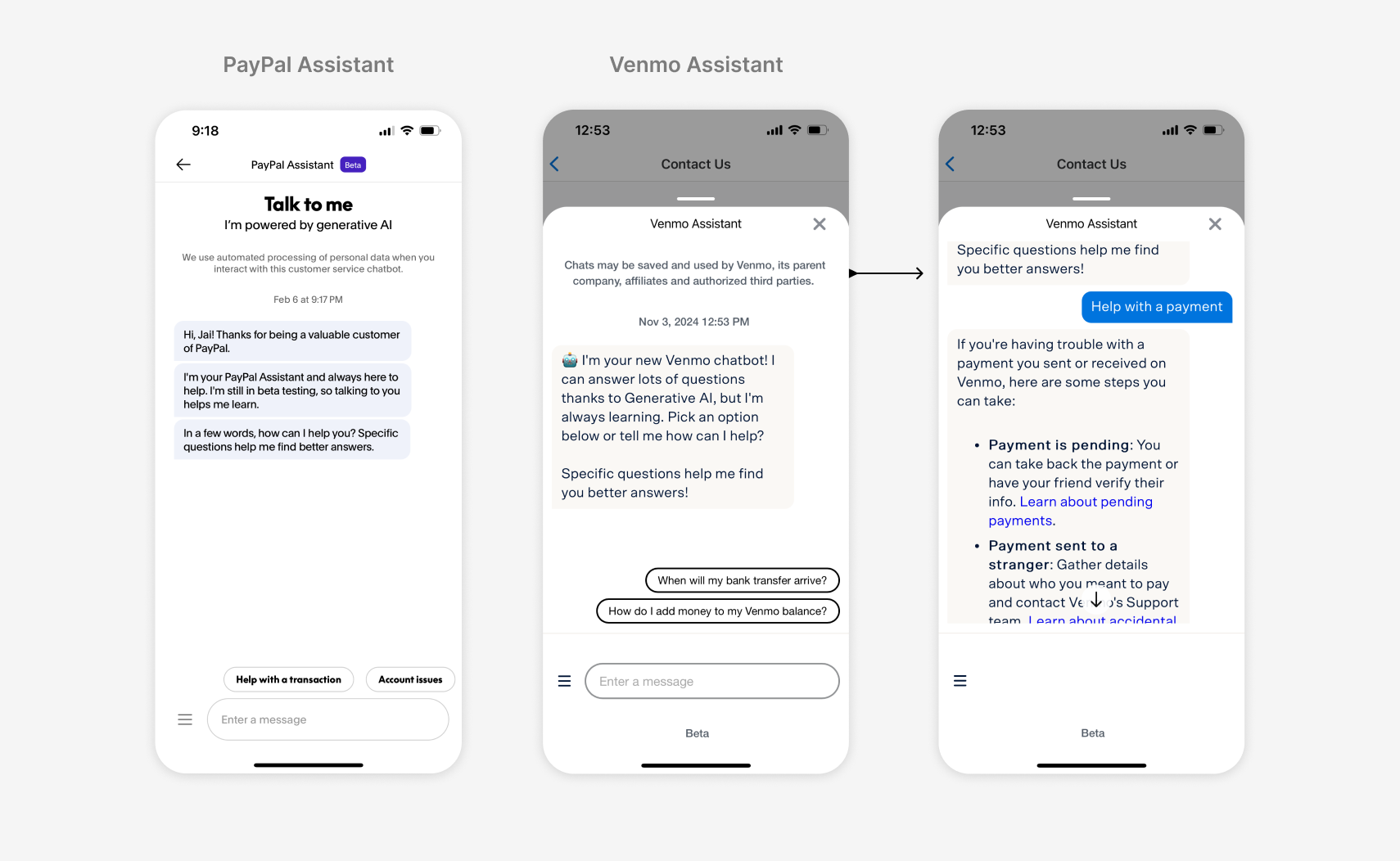
I collaborated closely with Venmo design to adapt PayPal Assistant for their brand, creating a platform solution that balanced consistency with brand authenticity.

As momentum around PayPal Assistant grew, we saw an opportunity to bring its benefits to Venmo, enhancing the customer experience while advancing shared business goals. However, Venmo's distinct brand identity and user expectations required a tailored approach. We couldn't simply replicate the PayPal experience. We needed to adapt it in a way that felt authentic to Venmo's voice and design language.

I fostered a strong partnership with the Venmo design team and its leadership, ensuring they were active collaborators in shaping the assistant experience rather than passive recipients of a platform solution. By aligning early on shared goals and co-developing solutions, we identified key moments, components, and design patterns that honored Venmo's personality while leveraging the platform's core structure.

PayPal Assistant platform messaging

Migrating from a single knowledge agent to a platform of dozens of specialized agents drove dramatically higher resolution rates, reduced contact volume, and quadrupled adoption of PayPal Assistant as a self-service channel.

As AI capabilities matured, we moved from a single knowledge agent to a purpose-built platform of dozens of specialized agents, each designed to handle a specific type of customer issue with far greater depth and accuracy than a generalist model could. This wasn't a simple feature update. It required a fundamental rethink of how the assistant was architected, how agents handed off to each other, and how customers experienced the transition between them. The result was a significantly more capable servicing experience that resolved more issues without human intervention, reduced overall contact volume, and saw customer adoption of the assistant grow fourfold.

PayPal Assistant generative AI

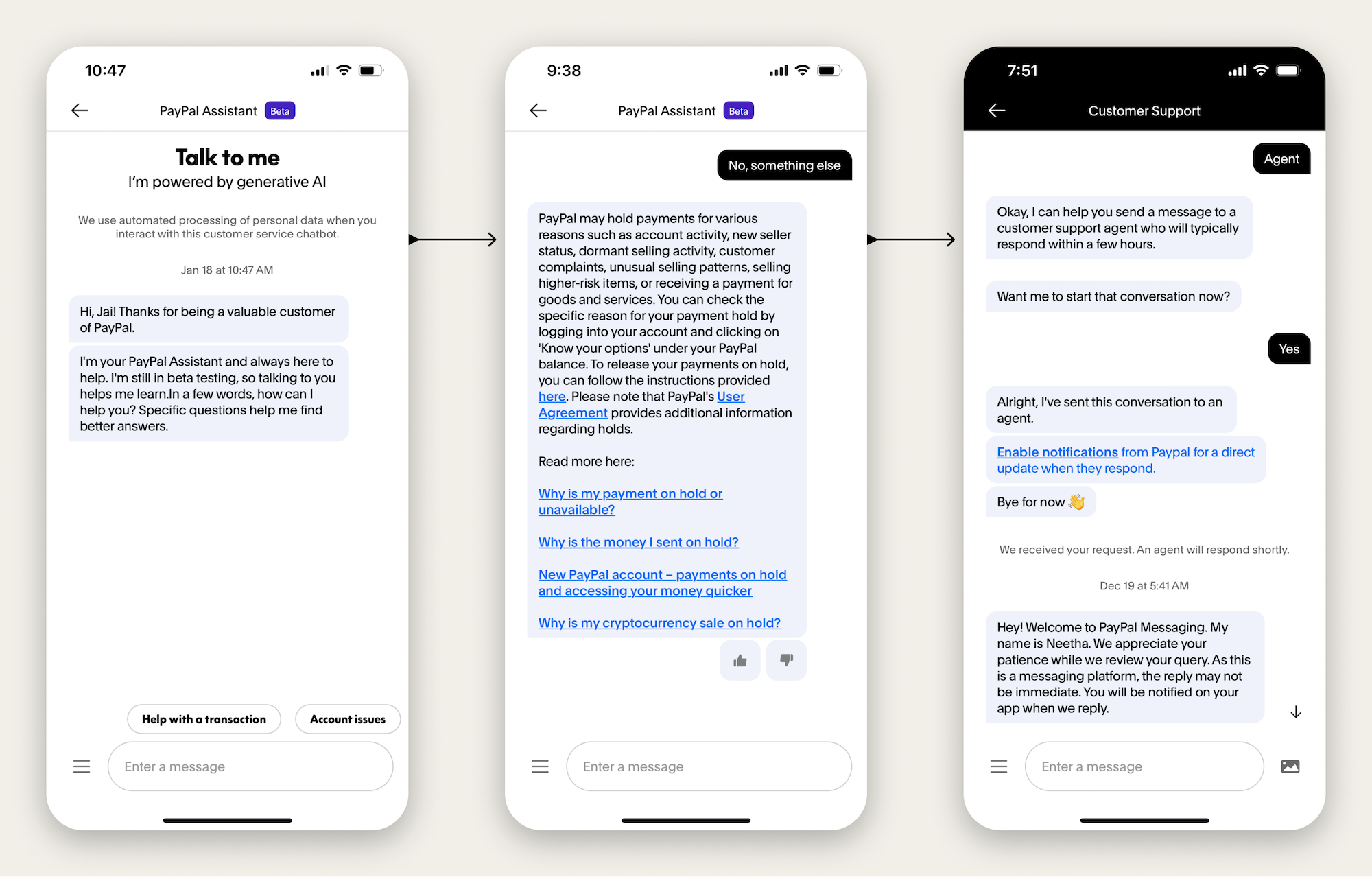
We designed clear visual and conversational indicators to signal AI-to-human transitions, ensuring customers always know who they're talking to.

A key part of the assistant experience is ensuring that the customer has a sense of place within that flow and clear indicators which make it immediately obvious whether they're chatting with an AI agent or with a human being. This level of transparency is critical. It builds trust with customers and creates ethical user experiences.

I led the design of clear indicators to signal this transition. The assistant explicitly communicates the handoff, the header changes color and title to signal the shift in modality, and visual representation shows who the customer is now talking to. These intentional design choices ensure customers always know whether they're interacting with AI or a human agent, building trust through transparency.

PayPal Assistant to agent transfer