Back to selected work

PayPal Personalized Shopping: Privacy & Consent

Challenge
A legal agreement update enabling PayPal to share recommendations with merchants required a new consent experience that built customer trust rather than eroding it, across a spectrum of privacy-conscious users and competing internal design directions
Outcome
A simplified consent interface enabling customers to control whether PayPal shares recommendations with merchants for more personalized shopping experiences
My Role
Led design for data and privacy settings, driving iterative usability research that shaped the final approach and validated key decisions with the voice of the customer

A single toggle in PayPal's data and privacy settings, letting customers consent to PayPal sharing recommendations with merchants based on their activity. Simple by design, not by default.

As part of an update to user legal agreements, PayPal gained the ability to share recommendations with merchant partners to create more personalized shopping experiences based on customer shopping history and preferences. This required introducing a new user consent setting, Personalized Shopping, that gave customers clear control over whether PayPal could share those recommendations with merchants.

The final experience was a toggle within the data and privacy section of the user profile, accompanied by a slide-up sheet providing more detail on what the setting does and how it works. While multiple design directions were explored, we leveraged iterative usability testing with customers to validate what landed across a variety of privacy user personas. The conservative, single-surface approach ultimately resonated most across the board.
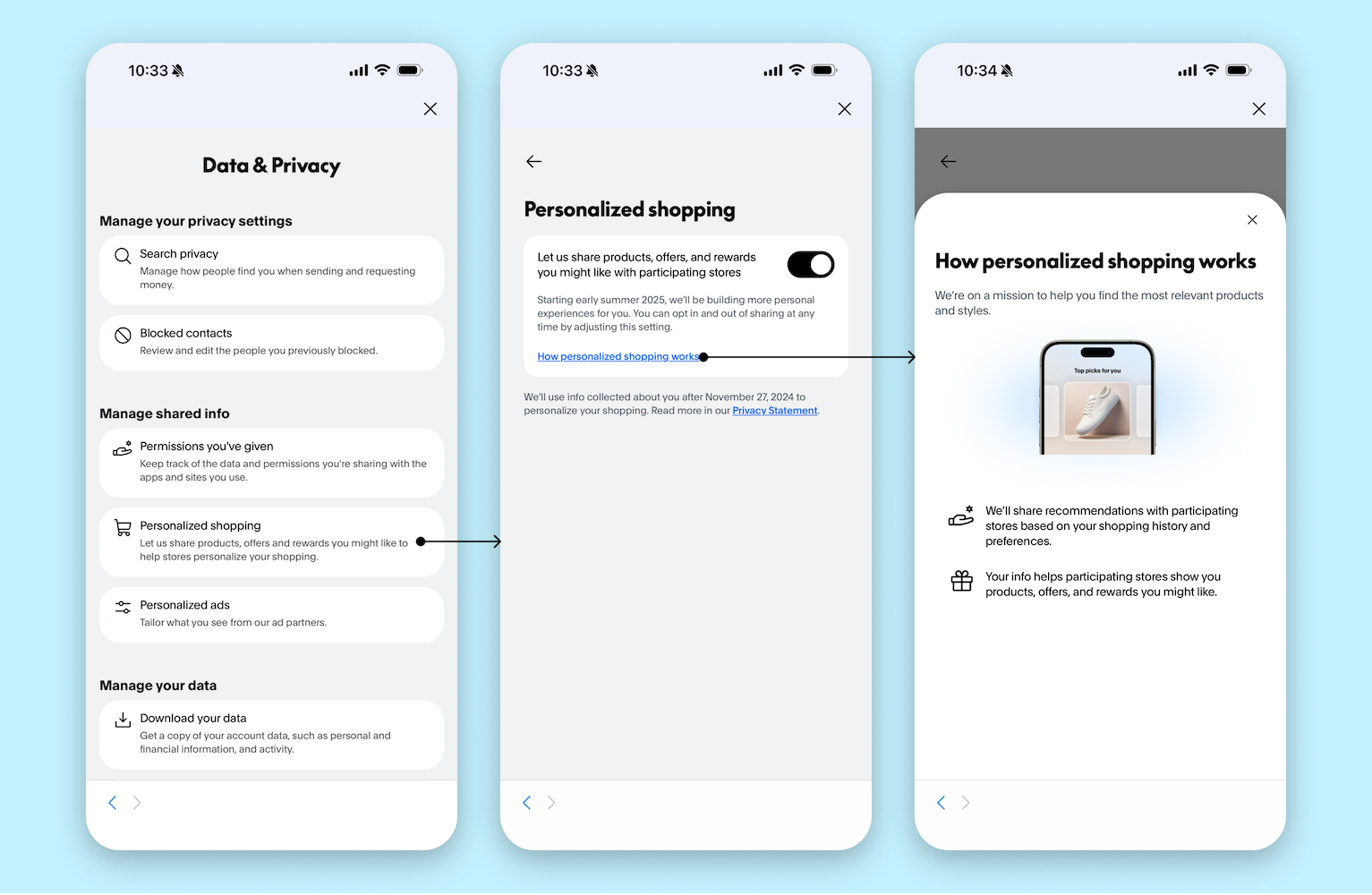
Personalized Shopping privacy settings

Three things this work made undeniably clear about research, transparency, and the power of words in experiences where trust is on the line.

This project was a concentrated lesson in how trust-sensitive experiences require a different standard of rigor, and how well-intentioned design decisions can backfire in ways you don't anticipate without the customer in the room.

01
Steady usability testing and concept validation with the customer can increase timely decisions and preserve project efficiency
There were weeks where misalignment between partners on particular concepts could have been avoided, or significantly shortened, by bringing in the voice of the customer earlier. Research isn't a phase at the end of the design process to validate final decisions. Especially in trust-sensitive work, it needs to be a continuous input that shapes experience decisions in real time.
02
Too much transparency can backfire
Even with the best of intentions of being open with the customer, over-communicating can create a high degree of concern that gets in the way of understanding what the explanation is really about. To that end, restraint isn't a demonstration of hiding things from the user but more being intentional about how much and across what channels to communicate new functionality to them, which may or may not affect how their data is used by others.
03
In trust-sensitive experiences, content is the critical piece that defines everything else
From information architecture down to the component level, the content design and strategy ultimately dictate whether trust is broken or maintained. The craft of choosing what to say and how to say it define what effective storytelling looks like within the customer experience. When the right people are empowered to do that work, the impact is significant and measurable.