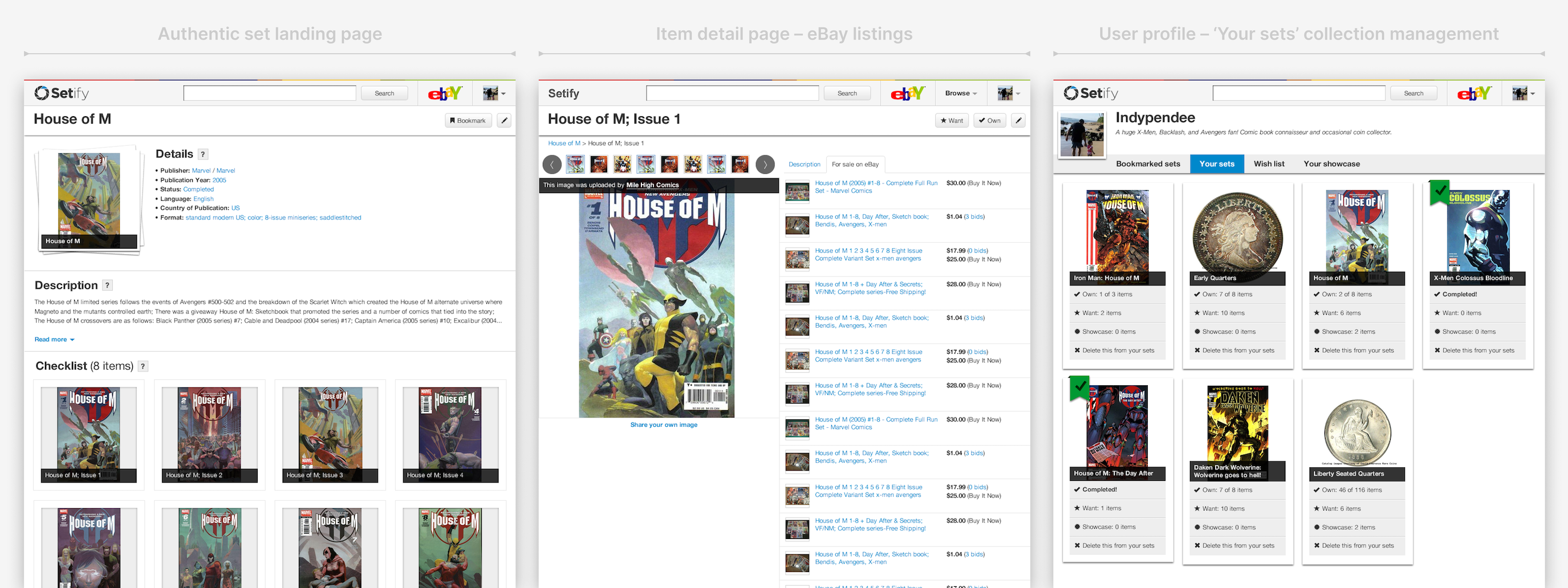
While eBay's origins began with the collector community, the marketplace as we know it today grew exponentially across customer segments, industry verticals, and globally. That coupled with the rise of startups who were able to operate in much leaner environments while shipping product at a faster pace presented a project opportunity that could tackle two problems at once. How might the eBay innovation team create a brand new in-house startup product that re-engaged eBay's original collector community while demonstrating the ability to pivot on existing product development processes and embrace the startup's lean approach to launching customer experiences.
Working with executive stakeholders across design, product, and engineering, we explored a range of concepts before landing on the insight that inspired Setify: Collectors more often than not work backward from authentic sets that dictate what they collect in order to complete their collection. Whether they're restoring a '67 Corvette Stingray using vintage auto parts or completing their collection of the original House of M comic series, the authentic set is the common thread throughout all collecting activities.
The experience was built around the collector's mental model, leveraging the authentic set as the key thread. Setify provides the platform for collectors to log in using their eBay credentials, search for the authentic sets they're collecting against, tag what they own and/or want, see their tagged items dynamically show their collection within their profile, and get links to eBay marketplace listings for missing items from their collection or items they want to upgrade.
We partnered with a third party agency to create a video that helped educate collectors on what Setify was and the value it brought beyond marketplace activity alone. Ultimately, this product represented the partnership and value eBay saw in its collector audience.
Setify required a different kind of process and the traditional eBay approach, which I was accustomed to, wasn't going to give us the kind of speed we needed to launch within what was considered an acceptable timeline. Our team, working style, and overall environment were built to emulate a lean startup experience. A small team, faster time to decisions, and a willingness to move before everything was perfect.
As the sole designer, I adapted my approach significantly by learning lightweight HTML and CSS prototyping and using tools like JSFiddle to hand off designs within the form of coded components to my partners. Engineering bandwidth was limited due to the size of the team and that had an impact on what product prioritized and in what order. If I relied on static mocks alone, I'm not entirely sure how much of what I had envisioned would have been built. Note: the screenshot below is from JSFiddle and is not the production code.
Seeing real collectors use the product, not in a research session but in the wild, was the payoff. Users came in and immediately understood what Setify was for. They started building their online profiles, tagging items in the authentic set pages, and managing their collections in a way that made clear the product had resonated with something real in their behavior.
The press coverage from TechCrunch, PCMag, and others was a bonus, organic validation that the concept was interesting beyond just eBay's existing user base.